

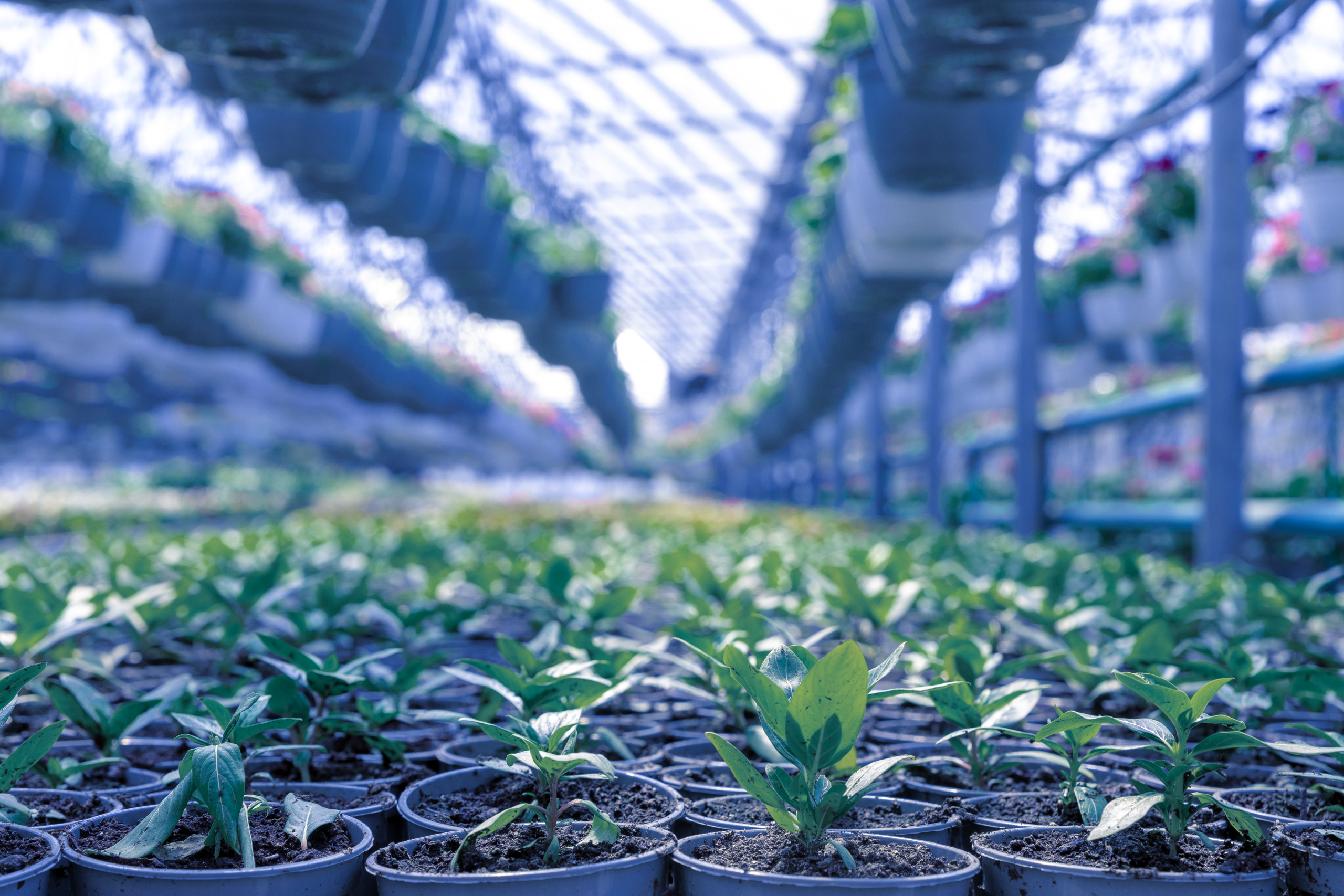
In the fourth and final article in our guest series on Controlled Environment Agriculture (CEA), Dr. Emilia Mikulewicz explores winter crop management in CEA systems and the importance of production zone to product batch traceability.
In winter, plant water and nutrient requirements change significantly. Irrigation based on a fixed schedule, limited ventilation, and prolonged canopy humidity in CEA can promote local disease outbreaks before the problem becomes visible across the entire crop. Therefore, the production system should allow the producer not only to react to symptoms, but also to identify where and why stability has been lost.
Assessing winter conditions
Winter crop management in CEA systems is a test of real control over production. Low radiation, cooler substrates, reduced transpiration, high humidity, and repeated condensation reveal weaknesses that may remain less visible in spring or summer.
As a result, decisions on irrigation, ventilation, fertilization, integrated pest management (IPM), hygiene, and harvesting then directly affect crop quality, food safety, and post-harvest performance.
From the GLOBALG.A.P. Integrated Farm Assurance (IFA) perspective, winter is not a certification risk in itself. Rather, risk arises when winter conditions are not reflected in the risk assessment, production records, corrective actions, and product batch control. In practice, what matters is not the occurrence of a problem, but whether the grower can demonstrate its scope, cause, response, and impact on a specific harvest batch.
Basil as an indicator of system instability
As a warm-season crop, basil can be a very useful indicator of winter instability in CEA. It responds quickly to low light, excessive humidity, and poor air movement. Its response often shows that the risk does not concern the entire facility, but a specific zone, irrigation sector, propagation batch, or harvest window.
This is important not only agronomically, but also operationally. If a problem can be assigned to a specific part of production, it is easier to limit its scope, separate the affected batch, and document decisions. If such separation does not exist, a local issue may become a quality or commercial problem affecting a much larger share of production.
Data-driven root-zone and fertilization management
Weak winter growth should not automatically lead to fertilization adjustments. Symptoms resembling nutrient deficiencies may result from a variety of factors:
- Lower light
- Cooler substrates
- Reduced root activity
- Excessive moisture
- Poor root-zone oxygenation
Increasing nutrient solution concentration without diagnosis may raise EC and deepen plant stress – especially when water uptake is limited. Similarly, routine winter irrigation may worsen the situation if it increases night-time humidity, condensation, and disease pressure.
In practice, decisions on water and fertilization should result from the assessment of plants, substrate, climate and the history of a given production zone, not from habit. In a well-managed system, every correction has a reason, location, date, and effectiveness assessment.
IPM, hygiene, and responsible actions
In winter, IPM should not be treated as a separate program. Its effectiveness depends on microclimate, irrigation, canopy density, the speed of removing infected plant material, and work hygiene. Softer tissues, slower growth, and longer-lasting moisture can change the dynamics of both diseases and pests.
Each observation should be linked to a production zone, an operational decision, and an evaluation of the result.
If plant protection products, biological products, or protection-supporting inputs are used, records should indicate the reason for application, area, product, dose, timing, responsible person, pre-harvest interval where applicable, and the outcome. This approach strengthens not only food safety and residue control, but also buyer confidence. It shows that the grower is not acting reactively, but managing risk in a controlled way.
Traceability from production zone to product batch
Winter problems in CEA are rarely uniform. One bay, tunnel, bench, irrigation sector, propagation batch, substrate batch, or harvest date may be more affected than the rest of the crop.
Lack of clear separation between production zones and harvest batches increases commercial risk. If a complaint arises regarding shorter shelf life, uneven quality, or disease symptoms, the grower should be able to reconstruct the history of that batch:
- Production location
- Harvest date
- Key technical decisions
- IPM observations
- Hygiene actions
- Corrective measures
This is where production meets certification. Documentation should not be a set of formal records created for the audit. It should reflect actual risk management inside the facility.
Four areas of winter control
A winter protocol aligned with GLOBALG.A.P. IFA risk-management logic should focus on real control, not on multiplying documents. The four key areas are:
- Control of root-zone activity before fertilization adjustments
- Treating humidity and condensation as risks for plant health and hygiene
- Assigning IPM observations and sanitation actions to specific production zones
- Maintaining batch traceability from production site to harvest and sale
This makes it possible to link differences in quality, post-harvest performance, or disease pressure to a specific part of production, management history, and the effectiveness of implemented actions.
Operational example: Condensation in one production zone
A grower observes repeated morning condensation in one production zone. In the same part of the facility, basil regenerates more slowly after cutting, and the first leaf symptoms appear. In a weaker system, the situation is treated as a general “winter problem”. In a more resilient control system, it is classified as a zone-specific risk.
The grower checks possible causes, implements a correction, documents the action, and evaluates whether the situation has improved. That zone remains separately traceable during harvest.
If a later complaint concerns shorter post-harvest performance from that harvest window, the grower can reconstruct the batch history based on data, records, and its link to a specific production location.
Adapting to winter conditions
In winter, the system does not forgive automatic routines. Irrigation, fertilization, ventilation, cutting, hygiene, and IPM responses should result from the real condition of the plants, substrate, and microclimate – not from habit.
First, identify where the system is losing stability. Only then adjust the technology. Otherwise, it is easy to treat symptoms: increase EC, intensify applications, or change the IPM programme, while the real source of the problem lies in substrate temperature, water management, condensation, poor air movement or lack of batch separation.
Professional CEA production is about seeing issues early, understanding their cause, limiting their scope, and having evidence that decisions were made consciously. This is what separates reactive crop management from a system prepared for an audit, a demanding buyer, and market pressure.

Dr. Emilia Mikulewicz
Dr. Emilia Mikulewicz is an agronomist with a PhD in agricultural and horticultural sciences and a Registered Trainer for GLOBALG.A.P. solutions including IFA, Chain of Custody, GRASP, and SPRING. She is a World Agriculture Forum (WAF) Council member, SAI Platform FSA Advisor Network member, and CEO of Cultiva EcoSolutions – supporting CEA and hydroponic producers with risk-based crop production systems, integrated plant health management, and GLOBALG.A.P. aligned compliance frameworks.
Related links
- Learn more about integrated pest management in CEA environments
- Discover the impact of hygienic zoning and nutrient solution control on CEA production
- Explore the benefits of the flagship IFA standard and get tailored support through the Registered Trainer program
